
[2026 Bedside Crib Guide] How to Choose a Baby Crib: What New Parents Should Know About Bedside Cribs
2026.01.06

For new parents, caring for a baby at night is both a sweet challenge and a practical test. Do you often run back and forth when your baby wakes in the night to feed or be soothed? Do you worry about the pressure or safety risks of sharing a bed with your baby?Baby Bedside CribIt is becoming the top choice for more and more families.
With limited living space and a busy parenting rhythm, balancing baby's safety, sleep quality, and parents' rest is a challenge many families face. Starting from real-life use, Mang Mang walks you through the different kinds of bedside cribs and when each suits, helping you find a way of caring that fits your life, so caregiving is easier and every night feels safer and more relaxed.
- What is a bedside crib?
- Is a bedside crib useful? Why do you need one?
- What are the benefits of a bedside crib?
- Until what age can a bedside crib be used? How to choose by your child's age
- Which family situations suit a bedside crib?
- How to choose a crib: bedside crib buying guide
- What crib styles are there?
- A recommended bedside crib: Face 2 Face bedside crib and crib size guide
- Any downsides to bedside cribs? Crib safety precautions
- How do you safely secure a bedside crib? Assembly guide
- How to clean and care for a crib
- Crib accessories matter too!
- Bedside Crib FAQ
- New parents' reviews of bedside cribs
What is a bedside crib?
A bedside crib (bedside sleeper) is a crib designed for babies that can also be used as a standalone crib. It is usually placed right next to the parents' bed, so the baby sleeps close by yet has their own sleeping space, and parents need to get up less often to care for the baby. More advanced bedside cribs can grow with your child and serve as a safe playpen or even a desk.
A bedside crib is usually made up of a frame and a small bed attached to it. It slides easily up to and away from the adult bed, and its height can be adjusted so that the baby and the adult lie at the same level. Parents can look after the baby from their own bed with just a reach of the hand, which is very convenient and supports baby's sleep quality as well as the parents' own. When using a bedside crib, pay attention to safety to avoid falls or suffocation accidents.
Is a bedside crib useful? Why do you need one?
Most adults change sleeping positions once asleep, and there is a risk of rolling over onto the baby's face and causing suffocation.
A "bedside crib" sits right beside the adults' bed, snug against the parents' bed. Besides making care easy for parents, it leaves the baby enough room to move. And if a baby gets used to sleeping in the parents' bed early on, it becomes very hard to train independent sleeping later. That's why bedside cribs have become a favorite among new parents and speak directly to what they need.
Why are bedside cribs selling more and more?
- Multi-functional, and some fold away to save space.
- As housing prices rise, many master bedrooms keep getting smaller.
- A bedside crib is a space-saving choice. Its smaller size suits homes with limited room.
- Parents can consider a bedside crib, which places the baby right next to the adults' bed, saving space and making care convenient.
What are the benefits of a bedside crib for kids?

Protecting Baby's Safety
A Comfortable, Reassuring Sleep Environment
Easier Feeding and Care
Encouraging Independence
Protecting Parents' Sleep and Intimacy
Until what age can a bedside crib be used? How to choose by your child's age
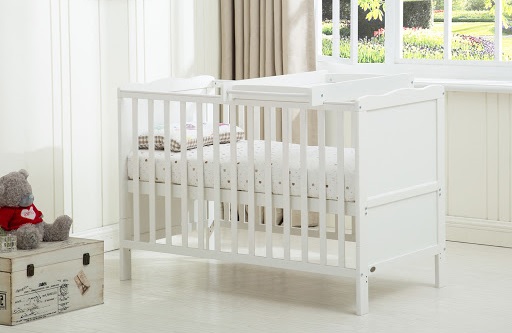
A crib's most important job is to protect a sleeping baby. Babies grow up asleep: an infant under one month old sleeps more than ten hours a day on average. A high-quality, comfortable, secure sleep environment ensures good sleep quality, which supports healthy development.
Crib Sizes and Age Range
Traditional cribs are generally designed for ages 0-6, so in theory a crib could be used until a child is 6. In practice, how long a child can sleep in it depends on its size. There are usually two sizes: standard (120x60cm) and mini (90x50cm), plus a larger size (140x75cm), commonly called a European/American large crib. With a standard crib, moms often share that kids can use it until about age 2-3; a large crib can last to around age 3-4. Beyond age 4, a crib is not recommended because taller children can climb out and tip over, which is unsafe. Alternatively, you can switch to the toddler-bed rail provided by the manufacturer so the child can get in and out freely without climbing.
With all that said, is buying a large crib more economical? It depends on whether your home has room. In reality, with housing prices so high, a single ping of floor space can cost many months of dad's salary. Whether your master bedroom is big enough for a large crib is a question of household budget.
What makes a good bedside crib? How to tell if a kids' bedside crib is qualified
- Meets national safety certification marks
- Carries inspection labels
- Gaps and materials meet standards
- Free of formaldehyde, heavy metals, and other chemicals
- Easy to assemble and clean
- Has straps to secure it to the adults' bed
Which family situations suit a bedside crib?
Many parents wonder, "Is a bedside crib right for our situation?" In fact, bedside cribs suit many situations. Consider one in cases like these:
- Small families with limited space: Small homes need to save floor space, and a bedside crib is both space-saving and practical.
- Newborns who feed often at night: When baby wakes and cries, parents can soothe quickly with less running back and forth.
- Single caregivers: You can pick baby up without leaving the bed, making care easier.
How to choose a crib: bedside crib buying guide
When choosing a crib or bedside crib, parents should consider many factors to keep baby safe and comfortable. Here are some important points to keep in mind:

- Size and adaptability
Choose a crib size that fits your baby's age and height, and make sure it fits your home. Some cribs can be extended with extra parts to last longer, converting into a desk, play mat, or sofa, which adds flexibility and improves value for money. - Safety testing
Prioritize cribs or bedside cribs that carry a national safety certification mark and are made of non-toxic materials. The crib board and parts should be impact-resistant and withstand baby's jumping without loosening. Choose paint free of heavy metals, and check that the rail spacing is under 6 cm to avoid the risk of baby getting stuck or falling.
- Convenience and Cleaning
A good crib should come with a mattress, storage bag, mosquito net, and other accessories to make it more convenient to use. Choose a cover that's easy to remove and wash to keep the crib clean and give baby a clean, comfortable place to sleep. If you often travel or stay overnight elsewhere, a lightweight foldable crib is ideal.
- Mattress support and safety design
The mattress should be firm to support a baby's still-developing bones. Avoid overly soft or spring mattresses, which may affect bone development or cause suffocation. Check the height of the base board regularly and make sure it is installed securely so loose screws don't become a safety hazard.

What crib styles are there?
Bedside cribs come in many types, including clip-on, sliding, and open-sided bedside cribs. Parents can choose the one that suits their needs and situation.
Bedside crib styles and what each does:
- Small portable: Light and easy to move, most install quickly, and are fine for travel and overnight stays, but because they are compact they are used for a shorter time.
- Multi-functional: Offers many features, so it lasts longer, but with so many functions each is only average rather than best-in-class.
- Large fixed: More stable than other bedside cribs, but needs more space and is heavy, so consider your home space and future storage before buying.
Recommended Bedside Crib: Face 2 Face Bedside Crib/ Crib Size Guide
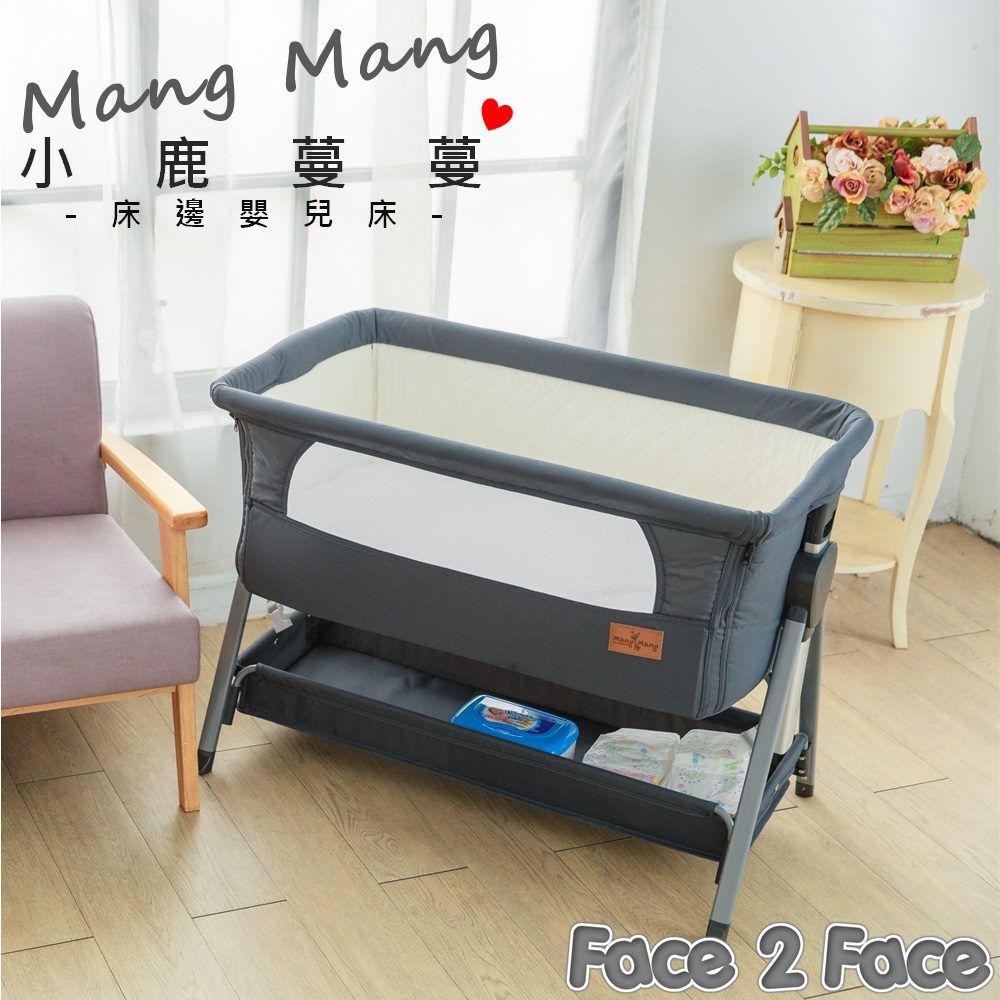
The Face 2 Face bedside crib works both as a bedside co-sleeper and a standalone crib, suitable from the newborn stage. It has 7 height settings and a rocking function, plus a breathable mattress and foldable legs, making feeding and soothing easier. The A-frame folding stand collapses quickly for portability and storage. Maximum load is 9 kg and the mattress is 5 cm thick, giving baby soft support without compromising safety.
- Size: 93x56x70~82cm (7 height settings)
- Only 14cm thick when folded, lightweight and space-saving
- Materials: aluminum tube, polyester fiber, foam sponge
- Colors: Graphite Gray / Mocha Brown
- One-year manufacturer warranty. Designed and made in China

"Graphite Gray" 、 and "Mocha Brown" two colors*

Bedside Crib Usage Notes
- When using bedside co-sleeping mode, never leave an infant alone in the crib; an adult must be present.
- Use this product only after confirming that all locking devices are secured.
- Do not use the product if any part is broken, damaged, or missing.
- Do not place any items inside or around the crib that a baby could grab or step on.
- Do not adjust or move this product while a child is lying in the crib.
- Always move the product on level ground, and lift your child out before moving it.
- Do not place any item in the product that would reduce its depth.
- Keep away from fire.
For more product details, see:[Mang Mang] Face 2 Face Bedside Crib
Any downsides to bedside cribs? Crib safety precautions

- Placement and Surroundings
Keep the crib away from windows, curtains, appliances, and other potential hazards, at least 50 cm away, to avoid accidental falls or suffocation risks. You can place a floor mat beside the crib to protect baby in case of a fall. Keep the room temperature and ventilation comfortable, using air conditioning as needed, with good light and airflow. - Convenient Breastfeeding and Care
A bedside crib makes night breastfeeding especially convenient: mom can meet baby's feeding needs without getting up repeatedly. After feeding, you can adjust the bedside crib's height to help prevent spit-up, so mom can rest right beside baby. This improves mom's sleep quality and means less fussing from baby. - Potential Risks and Safety Advice
Avoid cribs and bedside cribs with overly wide rail spacing to prevent baby from getting stuck. Also check the screws on the base board regularly to make sure it stays secure. When using a bedside crib, parents should stay alert, avoid medications or alcohol that affect consciousness, and follow the product manual for correct assembly and use. - Choosing and Using Bedding
Avoid long-pile blankets in the crib, which could cover baby's nose and mouth and cause suffocation. A breathable, slightly weighted blanket is safer, and you should check any mobile or decorations hung over the crib regularly, removing them in time as baby grows since they may become hazards.
How to Safely Secure a Bedside CribBedside Crib Assembly
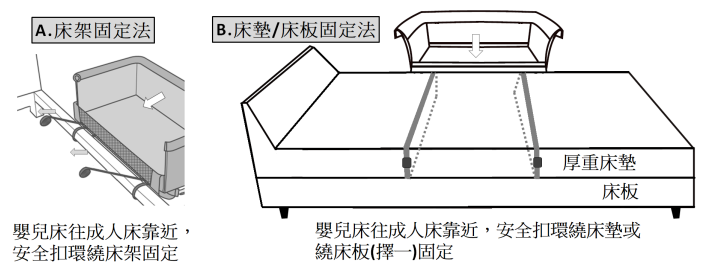
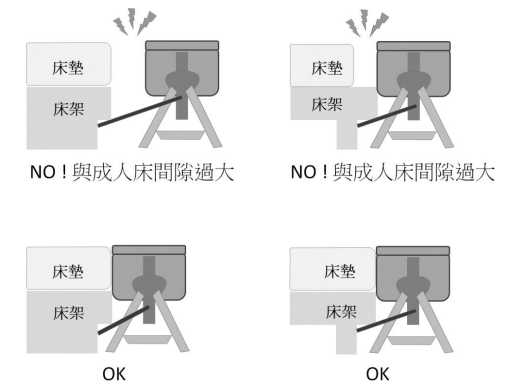
To keep baby close to you and sleeping safely, make sure there is no gap between the bedside crib and the adult bed when installing, and secure it firmly with the safety straps. Here are two common ways to secure it:
A. Securing to the Bed Frame
Position the crib as close to the adult bed's frame as possible and loop the safety strap around the frame. Suitable for beds with an exposed frame and no enclosed base.
B. Securing to the Mattress / Bed Board
If the adult bed has no exposed frame, you can also loop the safety strap around a thick mattress or bed board. Make sure the crib fits snugly against the side of the adult bed to prevent shifting.
✔ When secured correctly, there should be no noticeable gap between the crib and the adult bed, so baby can't get stuck while sleeping.
✘ If the gap is too large, it isn't secured properly; readjust the position and strap length.
Always check again before use that it is secure, and only use it once you've confirmed there is no gap!
Because baby is in frequent contact with the crib, it should be kept clean. Wash textiles around the crib at least once a month, and schedule washing for crib mobiles and comfort toys too. The simplest way to disinfect is to wipe with a dry cloth or wet wipe dampened with diluted bleach, hypochlorous acid water, or disinfecting alcohol. Don't put items back right away; air-dry them in a ventilated spot before use.
Clean the crib body according to its material:
Wooden Cribs
Wring out a damp towel and wipe the painted wood surface. Do not use detergent or alcohol, which may strip or dissolve the paint. For raw wood, use a food-grade wood protection oil or baby oil to care for it.
Fabric Cribs
Disassemble according to the manufacturer's instructions. If the board core is plywood, separate it from the crib body and do not soak it. After removing the fabric cover, always hand wash with mild detergent. If the manual says machine washing is allowed, use a medium or large laundry bag, fold the cover and roll it up like a spring roll before bagging it, then wash and air-dry in a ventilated place before use.
Also,for quick cleaning without disassembling a fabric crib,for reference:
A. Water-soluble stains (juice, saliva, urine, etc.)
Large areas: Soak a towel in warm water at about 50°C, wring it out, and wipe the whole stained area clean. Then blot thoroughly with a dry towel and air-dry in a cool place.
Small areas: Spray a little disinfecting alcohol on the spot, wipe with a wet wipe, and let it air-dry.
B. Greasy stains (milk, oil, mayonnaise, etc.)
Large areas: Dissolve mild detergent in warm water at about 50°C, wet and wring out a towel, and wipe the stained area clean. Then wipe off the detergent with a damp towel, blot thoroughly with a dry towel, and air-dry in a cool place.
Small areas: Spray a little disinfecting alcohol on the spot, wipe with a wet wipe, and let it air-dry.
Crib accessories matter too!
- Mattress. Don't choose a mattress that is too soft, as an overly soft mattress can affect a baby's bone growth. Press it with your hand to check it supports; you can also lay your baby on it and then lift them to see that the impression is about one centimeter deep. Experts recommend a firmer mattress for babies so that, if baby sleeps on their stomach, their head won't sink in and cause suffocation.
- Pillow. Babies don't need a pillow for extra comfort; they sleep fine without one, and head shape concerns can be addressed by adjusting sleeping position. Using a pillow too early, while a baby is not fully developed, can actually create safety concerns. Experts in many countries state clearly that, without supervision, babies under two should not use any kind of pillow, including baby pillows.
- Plush toys. Plush toys look cute in photos with baby, but they should not sleep with baby. Fluff may fall off and interfere with breathing, and plush toys that aren't washed often can harbor bacteria, dust mites, and other allergens that may trigger allergies.
- Blankets. In fact, nothing should be placed in the crib. Besides the pillows and plush toys above, blankets are best left out too; the crib should hold only a baby dressed and swaddled appropriately. If you worry about baby catching cold, turn on the heating or air conditioning or add clothing. Pediatricians advise against blankets for babies; suitable clothing is enough for warmth because blankets may interfere with breathing. There are now many products that stop babies kicking off blankets, so parents don't need thick blankets to prevent colds.
Bedside Crib FAQ
Q1: How do I assemble the bedside crib?
A1: Here are the installation steps for the Face 2 Face bedside crib:
- Components: base, storage basket, center support frame / mattress
- Unfold the base
- Install the center support frame
- Snap the storage basket legs into place
- Install the storage basket
- Place the breathable mattress
Q2: What are the features of your bedside crib?
A2: The Face 2 Face bedside crib has a maximum load of 9 kg and a large storage space that holds up to 5 kg. It has a see-through mesh side window, a soothing rocking design, and a dedicated mosquito net. It has 7 height settings, adjusted by pressing the adjustment button. The height difference between left and right helps prevent spit-up.
Q3: How do I convert the bedside crib to bedside co-sleeping mode?
A3: To convert the Face 2 Face bedside crib to bedside co-sleeping mode, there are two stages: opening the side and installing. The steps are:
Opening the side: Unzip, then press the hidden latch to detach the front support.
Installing: Measure the height of the adult bed and adjust the crib height. Take out the safety fastening strap at the side of the crib, loop it tightly around the mattress (or frame), and attach the buckle. Make sure it sits snug against the adult bed with no gap, and that the crib rail is lower than the adult mattress.
Q4: Will my baby become dependent on a bedside crib? How do we transition to independent sleep later?
A4: The bedside crib is designed to provide close care and a sense of security early on, and does not cause long-term dependence. Most babies can transition naturally to a regular crib or toddler bed after 6 months. If you're worried about the transition, choose a style with "removable side rails" or one that "converts to a standalone bed" to help baby adjust gradually to sleeping alone.
Q5: Do I need to fold up the bedside crib every day?
A5: No need to fold it daily, but if space is limited, we recommend a "foldable" style or one "with wheels" so it can be stored or pushed into a corner after use. If you want multi-purpose use (such as separate day and night rooms, or travel), choose a bedside crib with a quick-release, quick-fold design for more flexibility and convenience.
Q6: Can the bedside crib be placed directly on the floor?
A6: Most bedside cribs are designed to be used with an adult bed, with "level bed height" as the main consideration, and we don't recommend placing them directly on the floor. If you want to use one as a play mat or simple small bed, choose a style with a "standalone mode" or "fully lowerable side rails," and check that the base structure is stable and well ventilated.
Conclusion: Better Sleep Makes Parenting Easier
Want to create a safe, close sleeping environment for your baby? Choose a bedside crib that suits you today and enjoy every growing moment with ease.
👉 Click here to learn more about theFace 2 Face Bedside Crib, orcontact usto find out which one best fits your needs!
New parents' reviews of bedside cribs

With the Face 2 Face bedside crib, breastfeeding at night is so much easier 👍 It's also easy to take along on trips, and I love it. My husband says it's very light and totally fine to carry out. The color and style are fashionable and fit right in 😍😍 It's so useful that I bought one as a baby gift for a friend.
Related Products:[Mang Mang] Face 2 Face Bedside Crib